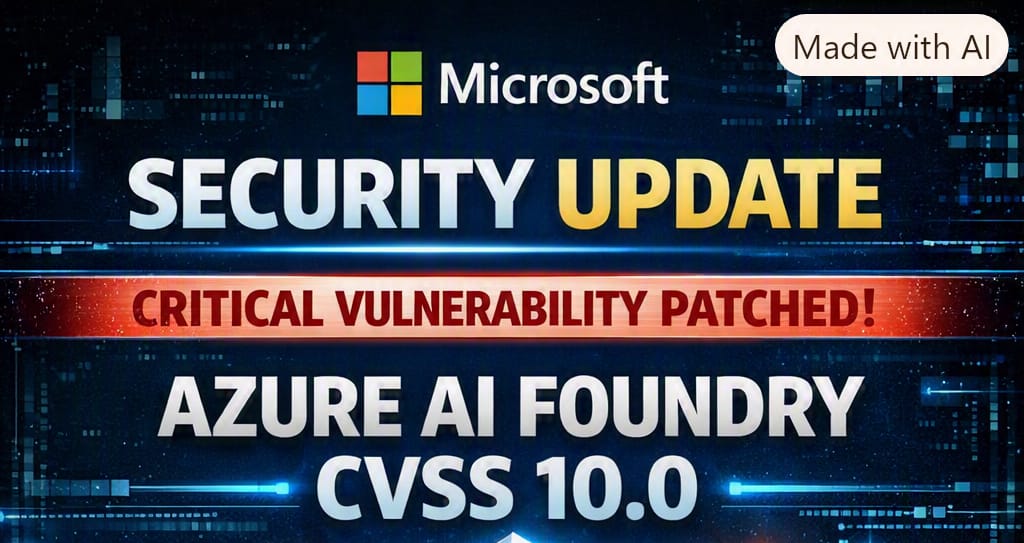

Microsoft has patched a critical CVSS 10.0 vulnerability (CVE-2026-85889) in Azure AI Foundry that allowed unauthenticated attackers to escalate privileges remotely. The flaw, caused by a missing authentication check, has been fully mitigated at the service level, requiring no customer action.
🔐 Key Details of the Vulnerability
- CVE ID: CVE-2026-85889
- Severity: CVSS 10.0 (Maximum)
- Root Cause: Missing authentication for a critical backend function (CWE-306).
- Impact:
- Allowed unauthenticated attackers to escalate privileges over the network.
- Could expose AI models, training data, enterprise resources, and downstream systems.
- Exploitability:
- Low complexity attack vector.
- No credentials or user interaction required.
- Rated as easily exploitable in theory, but no evidence of active exploitation has been found.
🛡️ Microsoft’s Response
- Patch Deployment:
- Microsoft applied a server-side fix globally across Azure AI Foundry infrastructure.
- No manual patching or configuration changes are required by customers.
- Researcher Credit: Security researcher Rémy Marot discovered and responsibly disclosed the flaw.
- Detection Guidance:
- No public Indicators of Compromise (IoCs).
- Customers may review Azure Activity Logs for unusual privilege assignments prior to patch deployment.
⚠️ Other Critical Fixes Released Alongside
Microsoft also patched several other high-severity vulnerabilities in September 2026:
| CVE ID | Product/Service | CVSS | Description | |
|---|---|---|---|---|
| CVE-2026-85885 | Microsoft 365 Copilot | 9.9 | Command injection flaw enabling privilege escalation | |
| CVE-2026-85878 | Azure Database for PostgreSQL | 9.9 | Improper authorization allowing privilege escalation | |
| CVE-2026-87701 | Azure Cosmos DB | 9.6 | Improper neutralization vulnerability | |
| CVE-2026-62721 | Windows User-Mode Power Service | 7.8 | Local privilege escalation to SYSTEM | |
| CVE-2026-85921 | Windows Secure Kernel Mode | 8.2 | Double free bug enabling Virtual Trust Level 1 access |
🚨 Risks & Recommendations
- Risks if Exploited:
- Full compromise of enterprise AI environments.
- Unauthorized modification or theft of sensitive datasets and models.
- Potential disruption of AI-driven business workflows.
- Recommendations for Customers:
- No immediate action required since Microsoft has patched the flaw.
- Monitor Azure Activity Logs for suspicious admin-level actions.
- Update internal threat models to account for privilege escalation risks in cloud AI platforms.
- Stay current with Microsoft advisories, as multiple critical vulnerabilities were disclosed in the same patch cycle.
✅ Bottom Line: The CVSS 10.0 Azure AI Foundry flaw was one of the most severe cloud vulnerabilities disclosed in 2026, but Microsoft’s rapid server-side patch means customers are already protected. Enterprises should remain vigilant by monitoring logs and reviewing related critical fixes in Microsoft’s September security updates.


 By
By